
Every insurer I talk to wants claims that keep up when a storm hits. Almost none want to explain to a regulator how an agent settled one.
In Australia, severe weather isn't a rare event to plan around. It's a regular test of every insurer's claims operation. And it's exactly when customers most need you to be fast, fair and consistent.
The surge problem in claims
On a normal day, claims flow through lodgement, assessment, supplier and payment teams. It isn't fast, but it works.
Then a storm hits and volumes jump overnight. The usual answer is temporary staff and overtime. That helps with capacity, but it creates a new problem: consistency. New people, working long hours under pressure, apply the same policy in slightly different ways. Customers notice. So do regulators, who expect insurers to meet the General Insurance Code of Practice whether it's a quiet Tuesday or the week after a hailstorm.
Underneath the surge are the same everyday frictions. Claims wait between teams. Handlers re-key data and check documents by hand. Evidence is chased by email. All of that multiplies when volume does.
What agentic claims changes
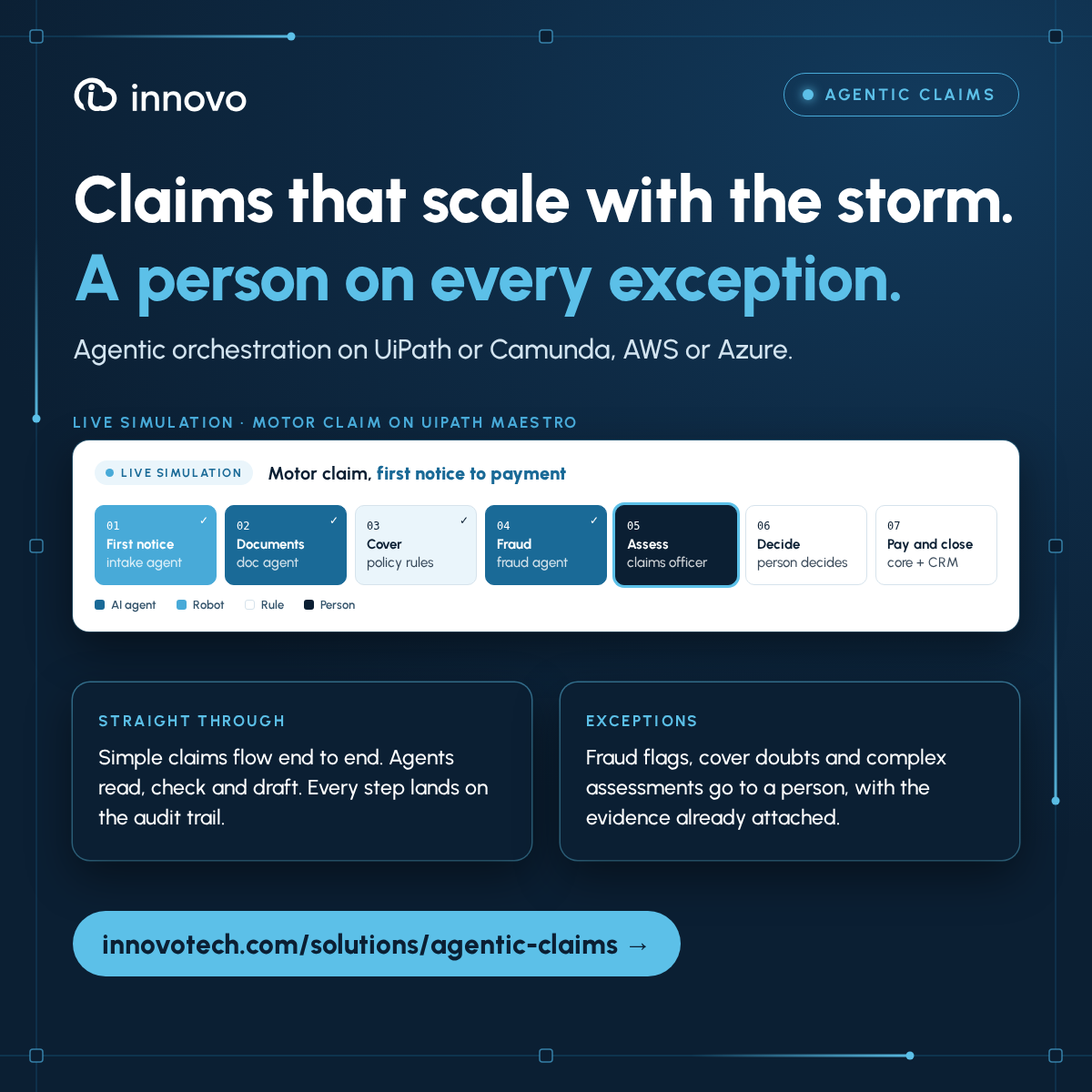
Agentic claims runs agents, rules and people as one governed process, from first notice to payment.
- Agents read the claim, check cover and assemble the evidence. They take the first notice, read photos and documents, check the policy and pull together what an assessor needs.
- Rules apply policy. Cover, excesses and limits are applied the same way on every claim.
- Exceptions go to a person. Any fraud flag, cover doubt or low-confidence result is routed to a claims officer.
- A claims officer holds authority on every exception. Agents prepare. People decide.
Simple claims go straight through. Complex ones arrive with the evidence already attached, so experienced staff spend their time on judgement, not paperwork.
Scale the process, not just the headcount
This is the real shift. When volume spikes, an agentic process scales. Agents take on the extra reading, checking and assembling, and the rules apply policy identically to the thousandth claim as to the first.
You'll still need people in a surge. But you need them for the decisions only people should make, not for re-keying data. And because every claim follows the same orchestrated process, the consistency that's hardest to hold under pressure is built in.
Governance a regulator will recognise
Speed in claims is worth nothing if you can't explain the outcome. In an agentic claims process, every step is on the audit trail: what the agents found, which rules applied, where a person stepped in, and who made the final decision.
That record matters when a customer disputes an outcome, when internal audit samples claims, and when you need to show you're treating customers fairly under the Code. It's also the foundation of sound agentic AI governance: controls designed into the process, not added afterwards.
See a motor claim run on UiPath Maestro
Our motor claim simulation runs a claim from first notice to payment on UiPath Maestro. An intake agent takes the notice, a document agent reads the evidence, policy rules check cover, a fraud agent checks for risk, and a claims officer assesses and decides. Payment and closure happen in the core and CRM systems.
Watch it run end to end, then take the controls and make the decisions yourself. Try to push it past a fraud flag and see what happens.
The same pattern, proven elsewhere
The governed pattern behind agentic claims isn't new to us. One lender we work with runs fully agentic on Camunda and AWS, with the same principle: agents do the work, rules hold the policy and a person decides every exception.
We deliver on UiPath or Camunda, on AWS or Microsoft Azure. Pick the platform that fits your estate. The governance doesn't change.
Where to start
Don't wait for the next catastrophe to find out where your process breaks. Start with one claim type, such as motor or home contents, and map where claims wait today. Usually it's lodgement, document checks and evidence gathering. Put cover rules into explicit policy rules, agree which flags always go to a person, and run the agentic process alongside your current one until you trust the outcomes.
Then test it the way the weather will: push a surge of synthetic claims through it and watch where people are still needed. That tells you far more about readiness than any capacity plan on paper.
Questions to ask before the next storm
- Where does your claims process slow down under volume? Is it decisions, or the work around them?
- How consistent are outcomes during a surge? Could you prove it?
- Who decides each claim, and is that on the record?
- Who runs the process after go-live? Our managed agentic AI service runs it 24x7, so it's ready when the weather turns.
See a claim settle itself
Explore agentic claims, run the motor claim simulation, or get in touch to talk about your claims operation.
So, a question for every insurance CIO: if the next storm doubled your claims overnight, could you show your regulator exactly who decided each one, and why?