
When someone dies, their family shouldn't spend most of a year chasing a super fund for the money.
Yet for too many families, that's the experience. They're grieving, they're dealing with an estate, and on top of it they're sending the same documents more than once, waiting for updates and wondering what's holding things up.
Most of the wait isn't the law
It's tempting to blame the complexity of death benefits on the law. There are binding and non-binding nominations, dependants to identify, estates to deal with and trustee discretion to exercise properly. That complexity is real, and it should take care.
But most of the wait isn't the law. ASIC's own review found most delayed claims were held up by things inside the fund's control. In practice, that tends to look familiar: documents sitting unread, requests not chased, steps done one after another when they could run side by side, and files waiting in a queue for someone to pick them up.
Those are process problems. And process problems can be fixed.
I wanted to fix that, so we built death benefit claims on UiPath.
How agentic orchestration speeds up a death benefit claim
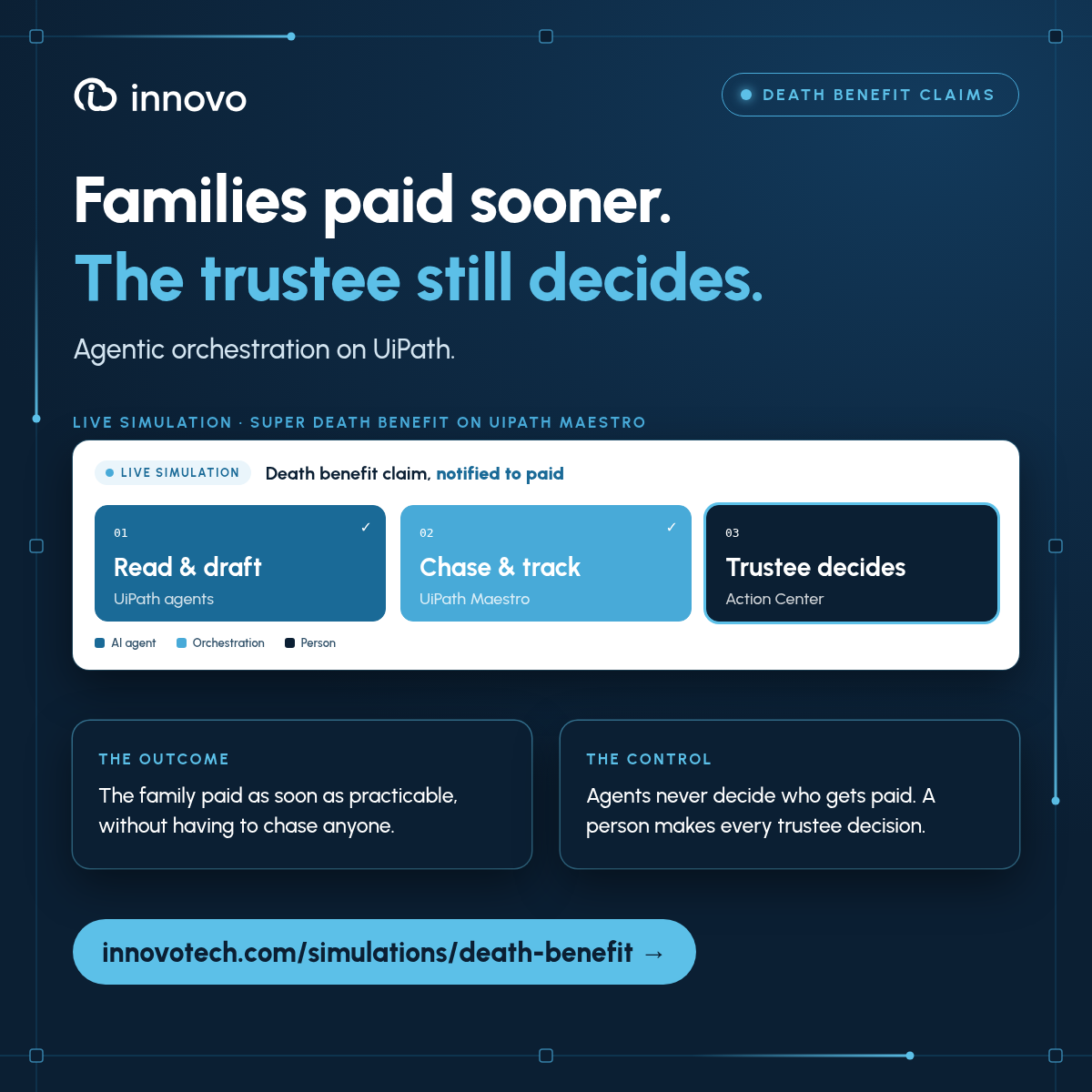
Our death benefit process runs in three parts, each with a clear job.
1. Read and draft: UiPath agents
UiPath agents read the documents as they arrive, such as death certificates, nomination records, identity documents and statutory declarations, and draft the claim file. Staff no longer have to read every page to work out what's there and what's missing.
2. Chase and track: UiPath Maestro
UiPath Maestro runs the steps side by side instead of one after another, and chases whatever is missing. If a document hasn't arrived, the follow-up goes out automatically and the claim doesn't sit idle. Every step is tracked, so anyone can see where a claim is up to.
3. Trustee decides: UiPath Action Center
A person makes every trustee decision in UiPath Action Center. They see the drafted file, the evidence and the nominations, and they decide. The agents prepare. The trustee decides.
The control that matters most
Agents never decide who gets paid. The trustee does, and every decision is on the record.
That's the line that makes agentic AI appropriate for death benefits. Deciding who receives a benefit is a trustee responsibility, often involving judgement about dependants and competing claims. No agent should make that call, and in our process none can.
What the agents do is remove the waiting around it. The trustee's time goes into the decision itself, not into finding out whether the paperwork is complete.
A file you'd be happy to show ASIC
Death benefits are firmly on the regulators' radar, and trustees are expected to pay benefits as soon as practicable and to treat families fairly along the way. When ASIC or your own auditors ask how a claim was handled, you want a complete answer, not a reconstruction from emails.
In an orchestrated process, the file builds itself as the claim moves: what arrived and when, what was chased, who reviewed it and what the trustee decided, and why. That's agentic AI governance working for families and for the board.
Where to start
Start by looking at your open claims and asking a simple question of each: what is it waiting for right now? Is it a document from the family, a review by your team, a response from an insurer, or simply a turn in the queue? The answers usually show quickly how much of the delay sits inside the fund's control.
From there, the first step is often the simplest: let agents read incoming documents and tell the family promptly what's still needed, while Maestro chases and tracks every outstanding item. The trustee decision stays exactly where it is. What changes is how quickly a complete file reaches it, and how rarely a family has to ask what's happening.
The outcome to ask for
The outcome I'd ask for: the family paid as soon as practicable, without having to chase anyone, and a file you'd be happy to show ASIC.
Watch a claim go from notified to paid
You can watch it run in our death benefit simulation: a claim from notification to payment on UiPath Maestro, with the trustee deciding in Action Center.
We build on UiPath for financial services, and we can run it after go-live as a managed agentic AI service, so the process keeps pace as your rules, products and systems change.
Questions for super leaders
- How long has your oldest open death benefit claim been waiting?
- How much of that wait is inside your control?
- Could you show ASIC the full history of any claim, today, from the system?
Talk to us
Run the death benefit simulation, explore member retention for super funds, or get in touch to talk about your claims process.
So, a question for every super leader: do you know today how long your oldest open death benefit claim has been waiting?