
Most super funds find out a member is leaving when the rollover request lands. By then, the decision has been made.
That's the uncomfortable truth about member retention in Australian super. The signal arrives at the moment it's too late to act on. The member has compared funds, picked another one and filled in the form. All that's left is to process the exit.
I wanted to change that, so we built member retention on UiPath.
Why retention is so hard to get ahead of
Funds aren't short of data. They hold years of contribution history, contact records, digital engagement and service interactions. The problem is that the signals that a member might leave are spread across systems, and nobody has the time to join them up for every member, every day.
So retention becomes reactive. A team works the exit list, tries a save call and records the outcome. Sometimes it works. Usually the member has already made up their mind.
Member retention is a big issue for funds right now, and it's a strategic one. Every member who leaves takes their balance, their future contributions and often their family's accounts with them.
Spot early, act first, you decide
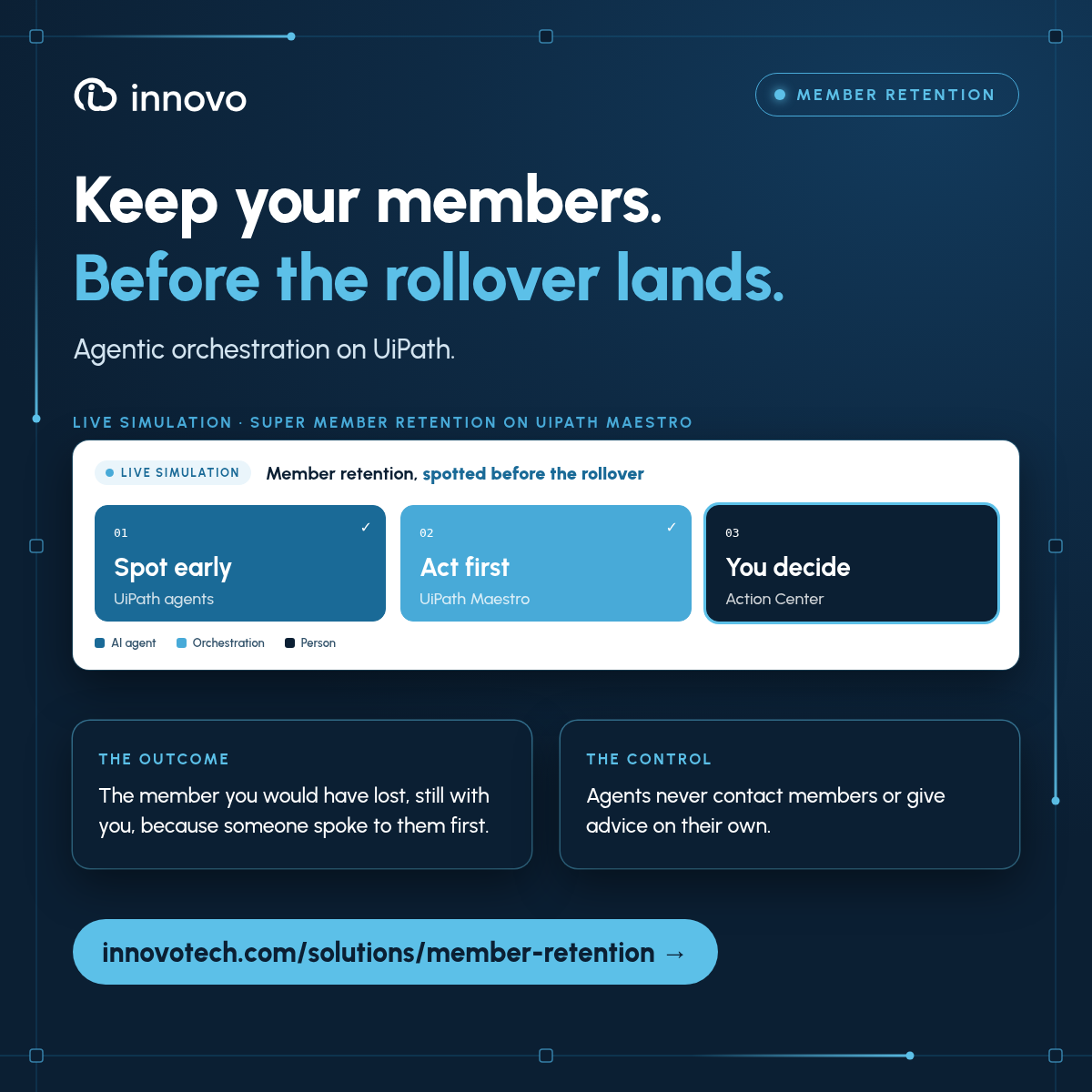
Member retention on UiPath turns retention from reactive to proactive, in three steps.
1. Spot early: UiPath agents
UiPath agents look across the fund's data for members showing signs they may be at risk of leaving, while there's still time to help. Instead of a list of people who have already gone, the team gets a short list of people who may be about to.
2. Act first: UiPath Maestro
UiPath Maestro orchestrates the work: gathering the member's context, preparing a suggested next step and routing it to the right person. Every step is tracked, so nothing falls between teams.
3. You decide: UiPath Action Center
A person approves every outreach in UiPath Action Center. They see why the member was flagged and what's suggested, and they decide whether and how the fund gets in touch.
The guardrails that matter in super
Super is a trust-based, heavily regulated business, so the controls are as important as the insight.
- Agents never contact a member on their own. Every outreach is approved by a person.
- Agents never give advice. Personal advice only ever comes from a licensed adviser. The agent's job is to make sure the right person knows to call, not to make the call.
- Every step is on the record. Why a member was flagged, who approved the outreach and what happened next are all on the audit trail.
That's what makes agentic AI acceptable to a trustee board: the agents do the noticing and the preparation, and people keep the relationship and the responsibility. It's agentic AI governance built into the process from the start.
Why this is different from a churn model
Plenty of funds have built churn models. Many of them sit in a data science notebook or a monthly report, because a score on its own doesn't change anything. Someone still has to notice it, work out what to do and find the time to do it.
The difference with agentic orchestration is that the insight is wired into the work. The agent's signal becomes a task, the task arrives with the member's context already gathered, and a person approves the next step in the same place they do the rest of their work. Nothing depends on someone remembering to check a report.
That's also what makes it measurable. Because every flag, approval and outcome is recorded, the fund can see which signals matter and tune them over time, with evidence rather than opinion.
The outcome to ask for
The outcome I'd ask for is simple: the member you would have lost, still with you, because someone spoke to them first.
Not a dashboard of churn statistics. Not a model accuracy score. A real member who stayed because the fund reached out at the right moment, with the right person and the right conversation.
Running on UiPath today, not a concept
This is running on UiPath today, not a concept on a slide. You can watch it in our member retention simulation: an at-risk member spotted, the work orchestrated in UiPath Maestro, and a person approving the outreach in Action Center.
We build on UiPath for financial services, and we can run it for you after go-live as a managed agentic AI service, so the signals, rules and approvals stay tuned as your fund and your members change.
Questions for super leaders
- How early do you know a member is thinking of leaving? At the rollover, or before?
- Who sees the signals today, and do they have time to act?
- Could you show your board how every outreach was approved?
See a member spotted before the rollover
Explore member retention, run the simulation, or get in touch to talk about your fund.
So, a question for every super leader: how many of your largest members would you know were leaving before the rollover request arrived?