
Every lender I talk to wants faster credit decisions. Almost none want to explain to a regulator how an agent made one.
That tension is real, and it's the right tension to have. Speed wins business. But in Australian lending, every decision has to stand up to responsible lending obligations, to APRA's CPS 230 expectations on operational risk, and to your own credit policy. Faster is only useful if it's also defensible.
Why credit decisions are still slow
Most of the delay in a credit decision isn't the decision. It's everything around it.
Applications wait between broker, credit and settlement teams. Analysts re-key data from one system into another. Documents are checked by hand, one by one. Each handoff adds waiting time, and each manual step adds the risk of a mistake that someone has to find later.
None of that work needs a credit officer's judgement. But it consumes their day, so the decisions that do need judgement queue up behind it.
What agentic lending changes
Agentic lending separates the work that needs judgement from the work that doesn't, and runs both inside one governed process.
- Agents read, verify and assemble the application. They extract data from documents, check identity and business details, pull financials and put the case together.
- Rules apply credit policy. Policy lives in explicit rules, not in an agent's interpretation of a PDF.
- Exceptions go to a person. Any KYC hit, fraud signal or low-confidence result is routed to a person, with the evidence attached.
- A credit officer holds authority on every exception. The agents prepare. The credit officer decides.
The result is a process where straightforward applications move quickly, and the hard ones reach an experienced person sooner, with the work already done.
Delegated authority is the guardrail that matters
The most important control in agentic lending isn't clever AI. It's delegated authority.
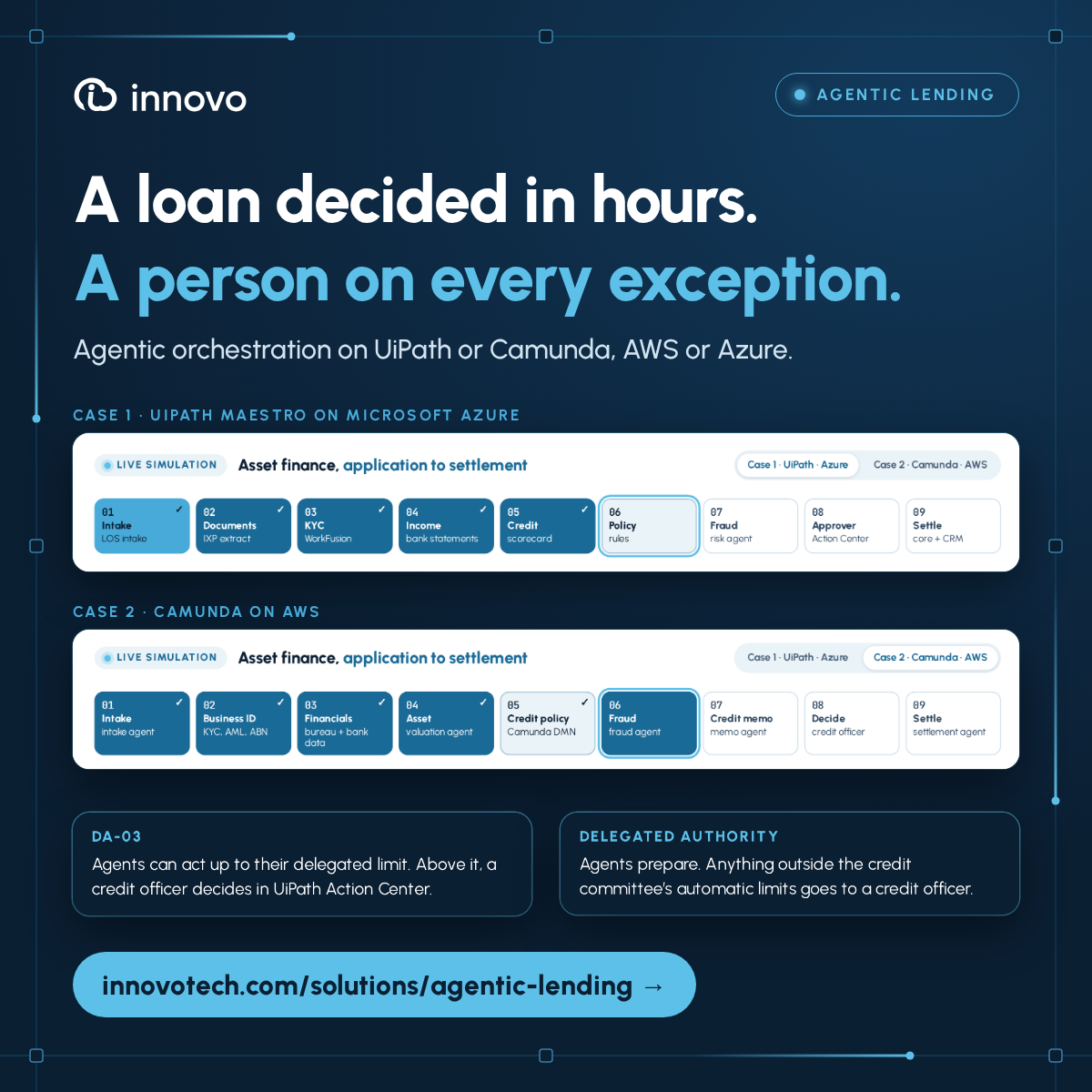
Every agent has a limit. Up to that limit, within policy, it can act. Above it, a named credit officer decides. In our lending simulation that rule is called DA-03: agents can act up to their delegated limit, and above it a credit officer decides.
Try it yourself. Take the controls in the simulation and ask an agent to approve a loan above its delegated limit. It's blocked. And crucially, nobody can switch that rule off from inside the process. The guardrail isn't a setting an agent, or a busy operator, can bypass on a Friday afternoon.
That's what your risk team needs to see before agentic AI goes near a credit decision.
Two platforms, one governance pattern
The lending simulation runs two cases, one platform each, to show that the governance pattern doesn't depend on the technology.
Case 1: UiPath Maestro on Microsoft Azure
A commercial loan orchestrated on UiPath Maestro on Microsoft Azure. UiPath IXP extracts the documents, KYC and fraud checks run as agents, and a credit officer makes the call in UiPath Action Center.
Case 2: Camunda on AWS
An asset-finance process on Camunda on AWS, with credit policy written in DMN decision tables. This is the same pattern one lender we work with runs fully agentic on Camunda and AWS, in production.
Pick the platform that fits your estate. The governance doesn't change.
What your regulator will ask, and how to answer
If an agent recommended a credit approval tomorrow, your regulator, auditor or board would ask three questions:
1. Who approved it? In a governed process, the answer is a named person or a documented rule within delegated authority, never "the AI". 2. On what basis? The evidence the agents gathered, the policy rules applied and the recommendation made are all on the record. 3. Could it have gone differently? The audit trail shows every step, every exception and every human decision, in order.
If you can answer those from the system itself, without a spreadsheet reconstruction, you're ready. That's what good agentic AI governance looks like in lending.
Where to start
You don't need to automate a whole lending book on day one. Start with one product and one stage where the waiting is worst, often document checks and application assembly. Put the credit policy into explicit rules, set the delegated limits with your credit committee, and decide exactly which exceptions go to which people. Then measure the waiting time before and after, on your own data.
Once that stage runs well, extend the same pattern to the next one. Because the governance is designed into the process, every new step inherits the same controls instead of needing a fresh risk review from scratch.
Running it after go-live
Credit policy changes. Products change. Systems upgrade. An agentic lending process needs to be run by people who understand how it was designed, so the guardrails stay intact as everything around them moves. That's why we offer it as a managed agentic AI service, 24x7, from the same team that builds it.
See a loan decide itself
The best way to understand agentic lending is to watch a loan go through, then try to break the rules. See the agentic lending offer, run the lending simulation, or talk to us about your own credit process.
So, a question for every CIO at a lender: if an agent recommended a credit approval tomorrow, could you show your regulator exactly who approved it, and why?