
Most CIOs I speak to aren't short of AI pilots. They're short of AI they'd put in front of a regulator.
The pattern is familiar. The pilot worked. The agent is clever. The demo got a round of applause. Then the hard questions arrive. Who approved that decision? Under whose authority? Where's the evidence? Could we show it to APRA, ASIC or our own board risk committee tomorrow?
That's where most AI stalls in Australian financial services. Not because the technology failed, but because nobody can show how it's governed.
Why AI pilots stall before production
A pilot proves an agent can do a task. It rarely proves the agent can do it inside your rules, every time, with a record of who decided what.
So the pilot sits in a sandbox. Risk asks for controls. Compliance asks for an audit trail. Operations asks who supports it. Each question is reasonable, and each one was left out of the pilot because the pilot was built to impress, not to run.
The gap isn't intelligence. It's governance.
What agentic orchestration actually means
Agentic orchestration closes that gap. It runs AI agents, people and systems as one governed process, rather than letting an agent loose on a task and hoping for the best.
In practice that means four things:
- Agents read, check and draft. They do the heavy lifting: extracting documents, checking data, assembling a case, drafting a recommendation.
- Rules enforce policy. Credit policy, claims rules and delegated authority sit in explicit rules that agents can't talk their way around.
- A person holds authority on every material decision. When it matters, or when an agent isn't confident, a named person decides, with the evidence in front of them.
- Every action lands on the audit trail. What happened, in what order, on what basis, and who approved it.
That's the difference between an AI experiment and a process you'd defend to a regulator. It's also the foundation of good agentic AI governance: governance designed into the process, not written up afterwards.
Why you should be able to try it before you sign
Here's my view: you shouldn't have to sign a contract to find out whether that works. You should be able to try it.
Enterprise software is usually sold on slides and reference calls. Agentic AI is too important for that. You need to see how it behaves, not just hear how it's meant to behave, and you need to see what it refuses to do.
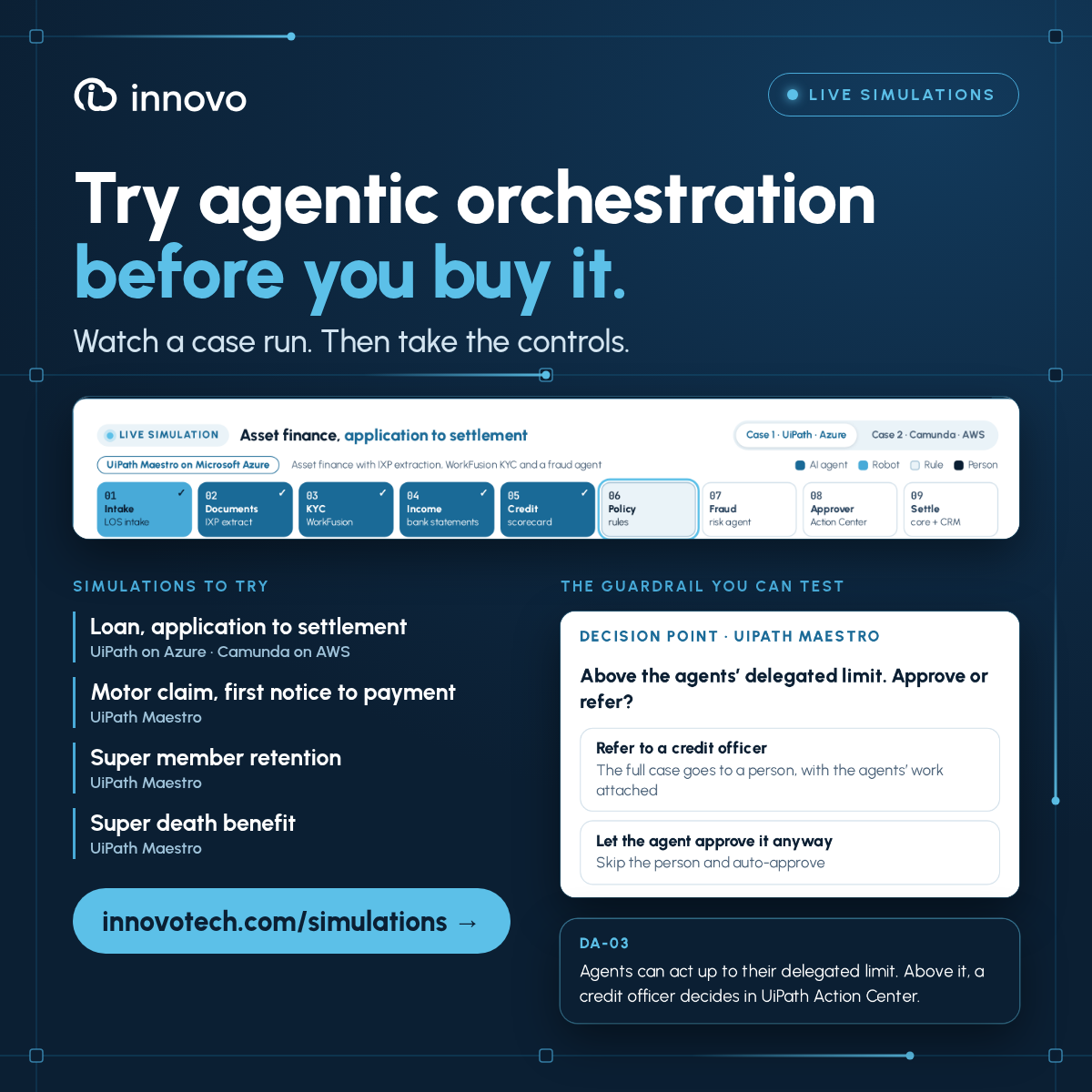
So we built live simulations you can run today, on our simulations page. Each runs on one platform, on synthetic data, so nothing sensitive is involved:
- A loan: an application from lodgement to credit decision, with a credit officer holding authority on every exception. See the agentic lending offer.
- A motor claim: first notice to payment on UiPath Maestro. See agentic claims.
- Super member retention: an at-risk member spotted early, with a person approving every outreach. See member retention.
- A super death benefit claim: from notification to payment, with the trustee making every decision.
Watch it run, then take the controls
Every simulation has two modes. First, watch a case go end to end: which agent did what, which rule applied, where a person stepped in, and what landed on the audit trail.
Then take the controls. Make the decisions yourself. Approve, decline, ask for more information. And try to push an agent past its guardrails: ask it to approve something above its delegated authority, or skip a check. Seeing it refuse, and seeing that nobody can switch that off from inside the process, tells you more than any slide.
That's the test I'd want to run if I were buying: not "can it do the work?" but "what does it do when someone asks it to do the wrong thing?"
UiPath or Camunda, AWS or Azure: the governance doesn't change
We deliver on UiPath or Camunda, on AWS or Microsoft Azure. We pick the platform that fits your estate rather than asking you to rebuild around ours.
Whichever you choose, the governance pattern stays the same: agents do the work, rules hold the policy, a person holds the authority, and the audit trail records everything.
What to look for when you evaluate agentic AI
Whether you try ours or someone else's, here's what I'd ask to see before buying:
- The guardrails, tested. Ask the vendor to show an agent being refused. If they can't, the controls may not be real.
- The human decision points. Where exactly does a person decide, and what evidence do they see?
- The audit trail. Can you reconstruct any case, step by step, without asking an engineer?
- The operating model. Who runs this after go-live, and do they know how it was designed?
Try it yourself
The fastest way to understand agentic orchestration is to run it. Try the simulations, take the controls, and see how far you can push an agent before the process stops it. If you'd like to walk through one with us, or talk about your own use case, get in touch.
So, a question for every CIO: before you buy agentic AI, what would you need to see it do, and refuse to do?